Is GUI Dead for AI Agents? The Full-Stack Agile Revolution Powered by CLI
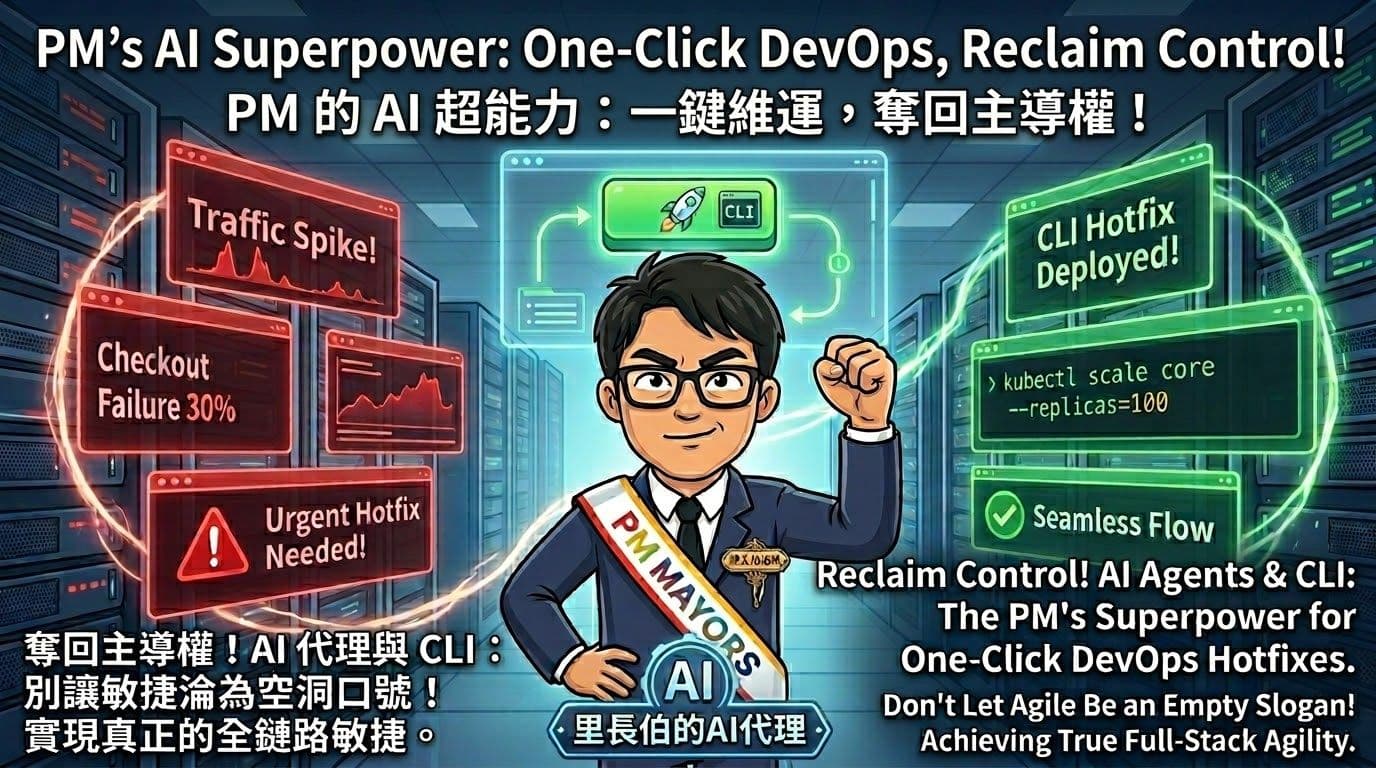
Don't Let Agile Become an Empty Slogan! How AI Agents and CLI Give PMs the Superpower of "One-Click DevOps" to Reclaim Product Control
Every day, I watch the industry talk endlessly about "Agile Transformation" and adopt various agile frameworks. As a Global AI SME, I often sit in these meeting rooms breaking a cold sweat. Most of the time, we chant the agile mantra, hold our Daily Standups, and cover walls with Kanban boards, but in reality, the only true agility happens in "frontend development."
Changing the color of a web button, tweaking a UI layout, or swapping a marketing Banner is undeniably fast. But the moment a request touches core backend business logic, server scaling, or underlying permission architectures, "agile thinking" devolves into a pile of Jira tickets that never seem to make it into the next Sprint.
Looking back at our blood, sweat, and tears in project management, PMs (Project Managers / Product Managers) are all too familiar with this scenario: When frontline sales report a system anomaly, or when we urgently need to tweak a business rule to counter a competitor's surprise attack, no matter how precise or perfect our User Story is, it hits a wall. "The backend engineers are at full capacity," or "DevOps doesn't have the bandwidth."
The result? We throw our hands up in the air, put on a brave face to placate the client, and force them to suffer through a flawed experience while waiting for the next "major system release." This helplessness—watching opportunities slip away while being unable to act—turns PMs into glorified messengers whose only job is to chase deadlines and deliver bad news.
This is exactly why I advocate that PMs must deeply understand the architecture of "AI Agents combined with CLI and CI/CD." The emergence of this framework completely shatters the deadlock. Today's PM essentially has a 24/7, on-call "virtual DevOps engineer" with the highest execution privileges right at their fingertips.
Crossing the Frontend Boundary: Why GUI is the Biggest Roadblock to "Full-Stack Agility"
Why has agile always felt like a half-measure? The root cause is that PMs rely heavily on Graphical User Interfaces (GUIs) to understand and operate systems.
When we want to launch a new promotion, we expect engineers to build a "promotion management dashboard" first. When we want to investigate why the system is lagging, we expect a "visual monitoring panel." This dependency on GUIs creates a thick wall between us and the underlying architecture. Developing GUIs is incredibly time-consuming, which is why your requests are always stuck in a queue.
But in the era of Agentic AI, the rules of the game have entirely changed.
The native language of AI is not a flashy webpage; it is the cold, pure, and highly efficient CLI (Command-Line Interface). When we upgrade our system architecture to be "Agent-First," the AI Agent becomes your ultimate chief of staff. It doesn't need you to draw wireframes or click web buttons. Through pure-text CLI commands, it bypasses the slow presentation layer and talks directly to the system's brain (the core backend or database).
This triggers a fundamental evolution in the Agile Workflow:
- The "Half-Measure" Agile of the Past (Passive Waiting): PM identifies a pain point -> Creates a Ticket -> Waits for the dev team's schedule -> Waits for DevOps availability -> Schedules server config changes -> Midnight downtime deployment -> Takes weeks, missing the golden window for fixes and counterattacks.
- The "Full-Stack" Agile of the Future (Lightning-Fast Hotfixes): PM identifies an issue and commands strategy in natural language -> AI Agent instantly generates and executes CLI commands in the background (e.g.,
ucp-cli config update --hotfix --module "checkout") -> Commands automatically trigger the CI/CD deployment pipeline -> The system performs a seamless rolling update in the background -> Zero-downtime deployment, taking only minutes.
Real-World Scenario: Taking Back Commercial Control and Crisis Management
What excites me the most is how this mechanism completely frees the PM from being a "resource beggar." Let's illustrate this with a high-pressure e-commerce Black Friday scenario:
【The Scenario】: At 12:15 AM on Black Friday, a massive traffic spike causes API congestion in the checkout system's "Bonus Points Deduction Module." The checkout failure rate surges to 30%.
-
The Traditional PM's Response: Frantically calls to wake up the Backend Tech Lead and DevOps engineers. A group of sleep-deprived people connects to the VPN, digging through logs and holding an emergency meeting. They finally decide to manually disable the bonus points module. By the time the command is executed, 45 minutes have passed. Countless customer complaints flood in, and millions in revenue vanish into thin air.
-
The PM with AI Agent Superpowers: Notices the abnormal drop in conversion rates and immediately opens the enterprise AI Agent collaboration channel, typing: "Checkout failure rate is spiking. Check the status of the bonus points module. If load is too high, execute graceful degradation on the module immediately and scale up the checkout core."
The AI Agent instantly reads the system monitoring logs, confirms the bottleneck, and executes a rapid combo in the background:
- Alters configurations via CLI:
shop-cli feature-flag disable --feature "bonus_points" - Commands K8s scaling via CLI:
kubectl scale deployment checkout-core --replicas=100 - These commands instantly trigger CI/CD and take effect within a minute.
- Alters configurations via CLI:
On the frontend, customers might merely see the page blink and notice the "apply bonus points" button is gone, followed immediately by a return to a buttery-smooth checkout experience. This is what a true "Agile Hotfix" looks like! And all of this magic stems from the PM leveraging the AI Agent and CLI pipelines with precision.
Commerce-as-Code: The PM's New Moat
Many PMs might panic at this point: "Chief, I really don't want to learn how to write code, and I don't want to look at a terminal full of black-and-white text."
Make no mistake! The essence of this revolution is this: You do not need to personally type into the black box of the terminal, nor do you need to understand obscure cloud network topologies. What you are learning is "how to orchestrate and architect."
When underlying operations and infrastructure can be CLI-driven and scripted, it means "Business Logic" finally equates to "Infrastructure." If you want to change a pricing strategy today or update the criteria for VIP membership upgrades, these are business decisions. In the past, you had to beg engineers to translate your decisions into code. Now, you simply explain the business logic to the AI, and the AI uses the CLI to "carve" that logic directly into the system.
This is known as Commerce-as-Code. Master it, and you master the soul of the product.
A Memorandum for the Agile Teams of Tomorrow
To make this vision a reality, I am making a loud appeal: To all PMs still agonizing over "insufficient resources," bravely embrace AI Agents and underlying automation architectures!
We need to condense DevOps operations—which previously required days of cross-departmental communication and endless meetings—into a few seconds of execution by an AI Agent.
Let the senior architects and DevOps teams focus on solving truly difficult technical foundations, security defenses, and high-availability architecture designs. Meanwhile, PMs should use AI Agents via CLI to execute second-level business logic validation, A/B testing, and disaster recovery.
This is a revolution that pushes the true spirit of agile down to the very foundation of our systems. Stop being a glorified messenger. Use your virtual AI DevOps engineer, and we can finally fight side-by-side with our development teams, ruthlessly taking back the true meaning of agile development and the ultimate control of our products!
Tags:
Want to Know More?
Get in touch to discuss AI transformation, teaching or speaking
