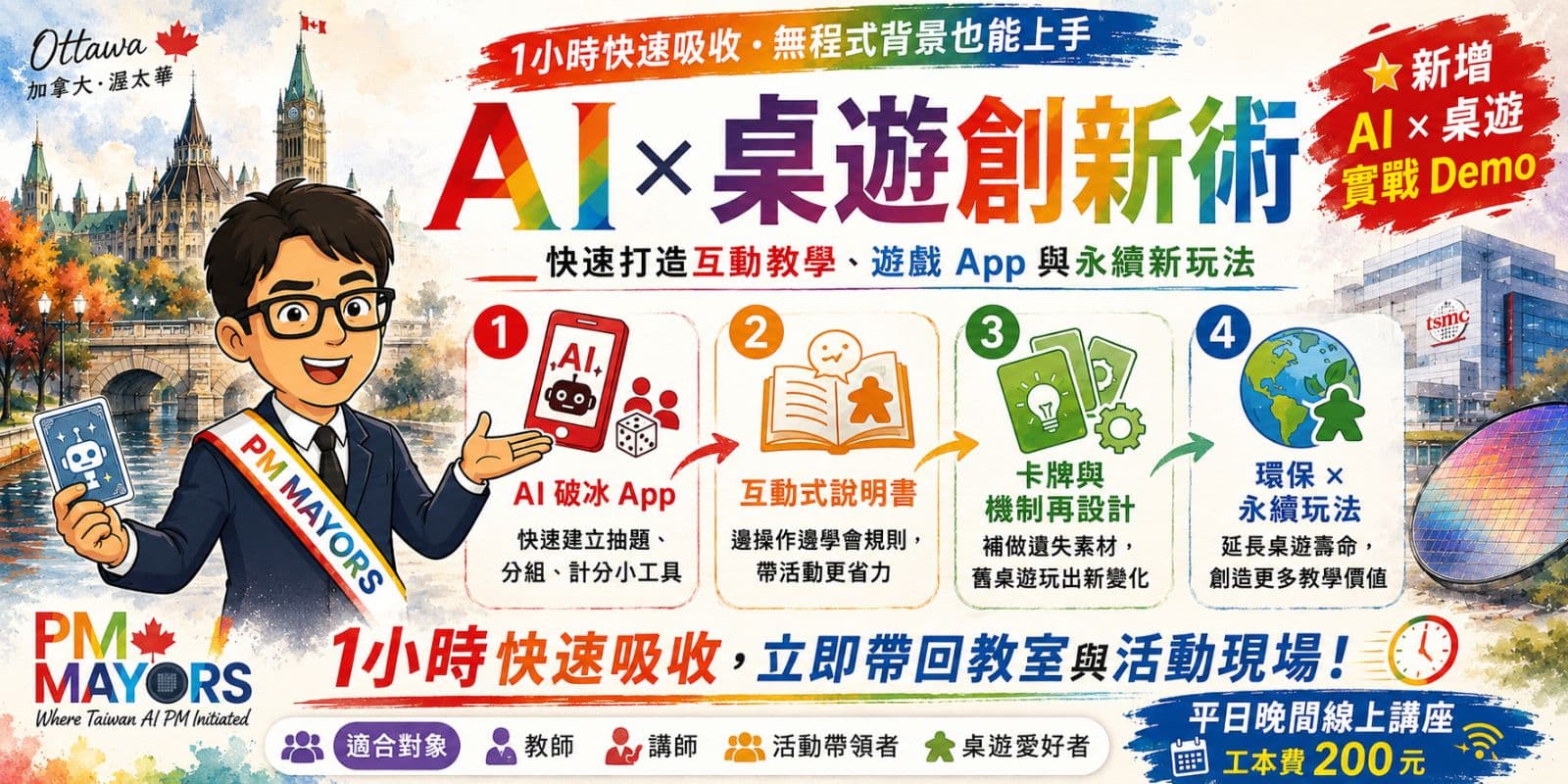
【Online Micro-Course】 AI × Board Game Innovation: Quickly Create Interactive Learning Experiences, Game Apps, and Sustainable New Ways to Play
This practical and easy-to-follow course will show teachers how AI can be applied to board game–based learning and activity design—all within just one hour. The session focuses primarily on hands-on demonstrations and live demos. No programming background is required, making it easy for anyone to quickly understand and apply the concepts.
Course Outline
📅 Course Outline
1. AI × Board Game Workflow: From Activity Needs to Interactive Experiences
Learn how AI can be integrated into board game-based learning and activity design, covering icebreakers, rule instruction, card design, and gameplay redesign to develop a complete understanding of its practical applications.
2. AI-Powered Board Game Icebreaker App: Energize Activities Faster
See how AI can be used to quickly create simple tools for question selection, team grouping, role assignment, score tracking, and mission challenges, reducing the preparation time required for activity facilitation.
3. Build Simple Interactive Apps Without Coding
Learn how to describe your requirements in natural language and let AI help you build simple, functional apps without starting with complicated programming code.
4. Transform Board Game Manuals into Interactive Guides
Turn traditional printed manuals into step-by-step, question-and-answer, or interactive tutorials, allowing players to understand the rules while playing the game.
5. AI-Powered Card Redesign
Use AI to rewrite card descriptions, design missions, generate questions, and create character backgrounds, giving existing board games more possibilities for expanded content.
6. Recreate Missing or Damaged Game Materials
Learn how to recreate missing cards, produce replacement materials, and develop additional missions, preventing an entire board game from becoming unusable because of one missing component.
7. Redesign Gameplay for Existing Board Games
Adjust game rules, winning conditions, cooperative modes, and competitive mechanics so that the same board game can offer different experiences for different age groups and learning objectives.
8. AI × Sustainable Board Game Design
Integrate environmental protection, circular use, waste reduction, and sustainable development concepts into board games, helping students understand real-world issues through play.
9. Extend the Lifespan of Board Games
Recombine existing cards, game pieces, dice, and accessories to develop new activities and lessons without purchasing new materials every time.
10. AI × Board Game Live Demonstration
Watch a live demonstration of the complete process, from identifying activity needs and building interactive tools to transforming rules, cards, and game mechanics.
11. Q&A and Discussion
Receive practical recommendations on AI applications and gameplay design based on the real-world needs of teachers, trainers, and activity facilitators.
