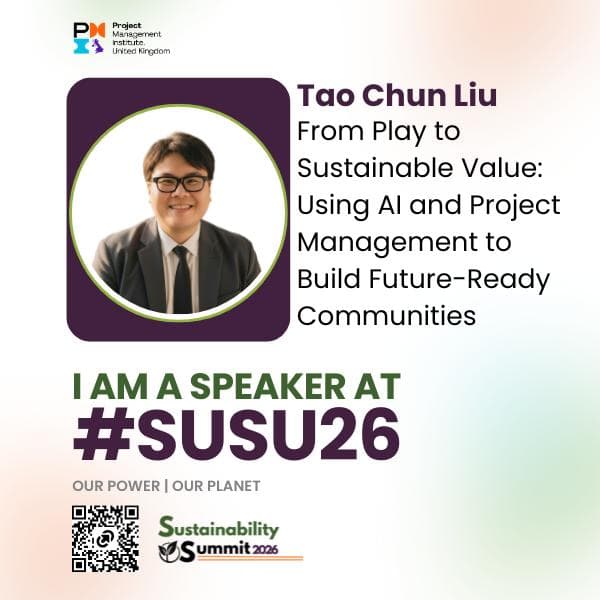
From Play to Sustainable Value: Using AI and Project Management to Build Future-Ready Communities
PMI UK Sustainability Summit 2026
Sustainability in project management is often associated with environmental reporting, compliance, and large-scale transformation. This session broadens that conversation by showing how project professionals can also create sustainable value through social impact, inclusion, and capability building at the community level. Drawing on more than 20 AI-guided learning and tabletop game initiatives, Tao Chun Liu will share how playful, low-barrier activities can be designed and managed as structured projects that deliver measurable value for people, communities, and long-term learning outcomes. Using examples such as AI Detective Academy, AI image generation, prompt-based storytelling, and logic-based tabletop games, the session demonstrates how children and families can build critical thinking, collaboration, AI communication, and problem-solving skills through engaging project-based experiences. The session will focus on practical application. Participants will be introduced to a simple delivery framework for designing community-based AI learning projects: defining intended value, identifying stakeholders, shaping safe and inclusive participation, planning activity flow, managing ethical and facilitation risks, and measuring outcomes through lightweight indicators. These indicators may include participation, engagement, repeatability, skill development, volunteer enablement, and community reach. The talk also explores how AI and rapid prototyping approaches can help project leaders create reusable learning experiences with limited resources. This supports not only social value, but also more sustainable delivery models by improving accessibility, reducing design effort, and enabling replication across schools, NGOs, and community groups. Aligned with the summit’s focus on moving beyond time, cost, and scope, this session shows how project managers can define success through measurable social and economic value, while supporting broader sustainability goals such as inclusion, education, and community resilience. It offers a practical and human-centered example of how project leadership can contribute to regeneration by building future-ready capabilities in the next generation.
Past event. External pages may be unavailable.
📸 Event Highlights